They say you can’t save everyone.
…

I had picked up an extra shift with Chelsea, a good friend of mine who I enjoyed working with whenever she didn’t have a partner. I knew what I was getting into when I signed up for the overtime, but Chels would make it a good day. She refused to have a bad attitude and I loved that about her. She was easy going, didn’t complain about catching calls, and provided good patent care.
The morning had been smooth so far. We were able to check off our equipment, grab our coffee, and sit in the truck for a bit, enjoying the ease into the day. But as always, the down time was short-lived.
The jingle of the unit pager woke me from my almost-nap. As usual, I had left my house incredibly early in the morning to make the two-hour trek to work. And, as usual, I took a few hours to get into the groove of the day.
Chelsea keyed up the microphone and told dispatch we were en route. We were responding lights and sirens to a patient with difficulty breathing. Unfortunately, the there was no added information for dispatch to provide at the time. We were responding with the fire department in a semi-new housing development that was 10 minutes away. Chelsea hit the lights, and we rolled out of the parking lot as I put my boots back on and fixed my pant legs.
We made it to the patient’s house after the fire department. Chelsea backed the ambulance into the driveway, and we hopped out of the truck and headed toward the door with the gurney in tow. We were greeted by a woman in her 50s who’s kind smile was overshadowed by the worry lines in her forehead and the tears prickling her eyes. She led us down a carpeted hallway and into the master bedroom where the fire crew was evaluating the patient.
As I made my way next to the fire medic, I watched as the patient tore the oxygen mask away from his face.
“I can’t. I just can’t do it.” He said through breathless gasps. He sat leaning forward in the desk chair, lips blue, face ashen gray. I glanced at the cardiac monitor. His oxygen saturation was less than 50%. Our monitors didn’t typically display the oxygen sats on the screen under 50%, so how far below 50 was anyone’s guess.
Jeff continued to coach the patient, allowing him to hold the mask inches from his face so that he didn’t feel so claustrophobic. When the patient shook his head, and agitated threw down the mask, Jeff turned to me. “His sats are low, but he won’t tolerate any oxygen. We’ve tried non-rebreather mask, nasal cannula, and he can’t even handle blow-by. This is how we found him when we walked in.”
I listened as Jeff gave me a condensed version of the events that led up to this moment. Frank had been in a motorcycle accident a week ago. He was transported to the hospital where he was then transferred to a trauma center for trauma evaluation. Frank was released from the trauma center with orders following up with a lung doctor and his primary care physician. He’d been diagnosed with a flail segment – a section of ribs that were fractured in two or more places. He had followed up with his doctor the day before. Everything had gone well, and they were to return to follow up with a doctor at some point.
Frank was still taking rapid, shallow breaths, but we knew that wasn’t the only problem. Jeff continued his assessment while Chelsea and I maneuvered the gurney in and around the tight corners of the hallway. I returned to Frank’s side once we had everything ready and in place. From behind I could see a section of Frank’s upper back moving opposite of his breathing. When he took a breath in, the rest of his rib cage would expand – but this section would retract and vise versa. This was our flail segment – our broken ribs. Jeff took out the stethoscope and listened to Frank’s heart and lungs.
“Lungs are clear,” Jeff announced. The fact that Frank was moving air in and out of his lungs surprised me. I assumed with an injury like that we might be anticipating a collapsed lung. This was something we were not going to figure out in the field, and time was something Frank didn’t have to spare. Wasting no more time, Chelsea and I instructed Frank how to position himself on the gurney, and with the firefighters’ help we secured him with the seat belts.
“I have to s[***]!” Frank called out, “Before we go I have to use the bathroom.”
I caught Jeff’s eye and shook my head aggressively. Jeff was on board and acknowledged the non-verbal message. He explained to Frank that it wouldn’t be possible to allow him to use the restroom. I piped in and told him his condition was critical, and we needed to get him to the hospital. Plus, I didn’t want him to code on the toilet. Frank was on the larger side and if he went into cardiac arrest while having a bowel movement, it would be difficult to get him out of the bathroom.
“So I’m thinking some Versed.” I said to Jeff as we loaded Frank into the ambulance.
“You read my mind.”
I enjoyed running calls with Jeff. He was a medic who never discounted my treatments, paid close attention when I spoke, and always thought critically in the best interest of the patient. He had a positive upbeat vibe about him, even in critical situations. Jeff had no time for being a grump. Anyone could tell he enjoyed his job and took it seriously.
Since Frank was so hypoxic, the lack of oxygen circulating in his blood was causing high levels of anxiety which prevented us from preforming life saving interventions. He needed oxygen. Fast.
Chelsea secured us in the back of the truck and Jeff and I each took a side of the gurney.
“First one to get the IV gets to push the meds,” I challenged.
Jeff and I each unwrapped and IV kit and tied a tourniquet around each arm. We each got an IV at the same time. I popped the cap of the Versed, the only sedation drug I had in my drug box, and drew the contents into the plastic syringe. I slowly pushed the clear liquid through Frank’s IV and watched as his breathing became slower – his anxiety settling.
“Perfect.” I said, tossing the syringe into the sharps bin. Jeff replaced the oxygen mask over Frank’s nose and mouth, and we waited a beat for the sats to improve.
Jeff sat on the bench seat while I took my spot in the airway seat to watch the cardiac monitor. We both noticed Frank drop his chin to his chest at the same time. Jeff shook Frank’s shoulder and called his name. No response.
“His oxygen isn’t coming up.” I told Jeff.
Jeff took his knuckles and ground them onto Frank’s chest, looking for a response. Nothing.
“I don’t think he’s breathing,” Jeff said removing the oxygen mask. He put his index and middle finger to Frank’s neck. “I don’t feel a pulse.”
I mimicked Jeff’s actions on the other side. “I’ve got a pulse, but it’s faint.”
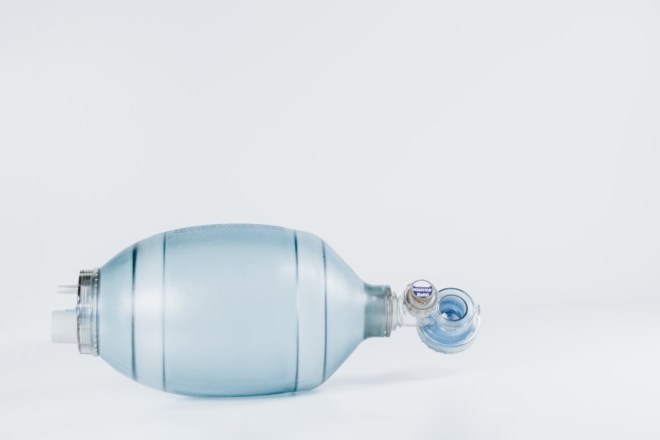
After that our actions were so fluid – mechanical and methodical at the same time. Jeff removed the cardiac monitor from back of the gurney and placed it on the bench seat. I laid the gurney flat and grabbed the BVM out of the cabinet. I gave Frank a couple quick breaths and felt for spontaneous breathing. Jeff felt for a pulse again at Frank’s neck and wrist.
“I got nothing.” He said. I checked the same places and confirmed that I didn’t feel a pulse either. “Starting compressions.” Jeff verbalized to me.
I called up front to Chelsea, “We’re working a code.” Chelsea copied me and told me we were eight minutes from the hospital.
As Jeff pushed on Frank’s chest I grabbed my drugs and an OPA – an airway adjunct used to keep the patient’s tongue off the back of the throat to allow for ventilation.
“27, 28, 29, 30.” Jeff counted out. I inserted the OPA and breathed twice for Frank. Jeff resumed compressions and I grabbed the epinephrine. I slammed the drug through Frank’s IV fast and flushed the line with saline. I attached a liter of saline to the tubing and then secured that to Frank’s IV as well. “28, 29, 30,” Jeff had finished another round and I breathed twice for Frank again.
“I don’t know what happened. Five milligrams of Versed shouldn’t have made him code?” I was panicking inside.
Did I kill Frank?
Jeff agreed with me. Frank was a large man, weighing somewhere around two-hundred and fifty pounds and standing at five foot 8. The Versed should have made him sleepy or relaxed, not put him into cardiac arrest.
While waiting for Jeff to finish his round of compressions, I picked up the phone and called the hospital. My patch to the charge nurse probably sounded something like, “Hi, this is Medic Two en route working a full code. We’ll be there in five.” Click. Not one of my shining moments.
We continued CPR for the next five or so minutes, pushing epinephrine every three minutes. Pulling into the ambulance bay we finished the last compression. Jeff and I each pressed our fingers to Frank’s carotid artery.
“I’ve got a pulse,” I said, breathing for what felt like the first time. Frank was still not breathing on his own, but his heart had restarted. I continued to breath for him as Jeff and Chelsea secured the saline, and changed over the oxygen from the truck to the jump tank on the gurney.
We flew into the ER and were directed to room one. The doctor, nurses, and techs filled the large room as we disconnected Frank from our equipment to the hospital bed. I heard Jeff giving the report to the doctor at the door.
Brandy and two or three techs helped slide Frank to the ED bed and I began to rattle off the story, hopefully coherently. Chelsea hurried the gurney out of the room as the crowd of other healthcare workers descended on us.
“He coded en route right after I gave Versed,” I told Brandy. “He was in a motorcycle accident a week ago and was transported to a trauma center. He was released and diagnosed with a flail segment. When we showed up he was breathing fifty to sixty times a minute and wouldn’t tolerate any oxygen. I gave him Versed for the excited delirium and anxiety. For a second we thought everything was all good, but then he stopped breathing. We bagged him, but then he went into cardiac arrest. Then we restarted CPR. He got a total of three epi’s, and we did three or four rounds of CPR. We just got pulses back in the bay.”
At least, that’s what I thought I said. My head was swimming and I couldn’t tell if anything that came out of my mouth made sense.
The tech checked for a pulse and noted Frank had coded again. “Starting compressions,” he announced to the room.
 Holly Writes and Reviews